
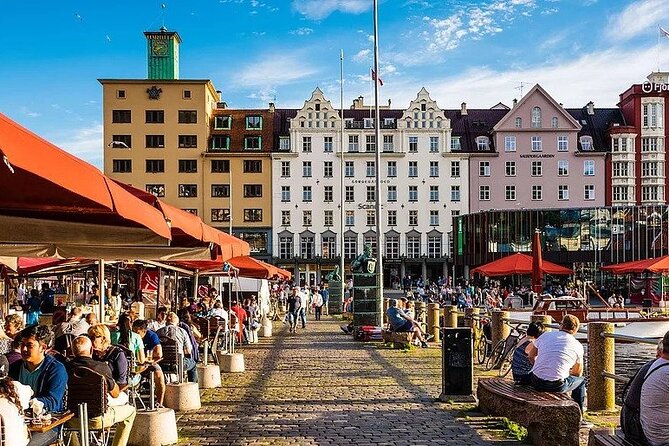
Reviewed · CITY TOURS
Bergen City Cruise
Bergen’s story begins at the water, and this cruise gives you a fine first look at the city without asking your feet to climb another hill. From the harbor, you’ll see UNESCO-listed Bryggen, old wooden neighborhoods, Bergenhus Fortress, fjord scenery, and the huge submarine bunker at Laksevåg. I like the way the boat turns familiar sights into a single, easy-to-follow picture of the city.
I also like two practical things: the one-hour length fits neatly into a busy day, and blankets are available when Bergen serves up its usual cool, damp weather. The main consideration is the narration. Some departures have recorded commentary rather than a live guide, and several people found it bland, hard to hear outside, or too easily drowned out by onboard conversation.
Key points to know before you board
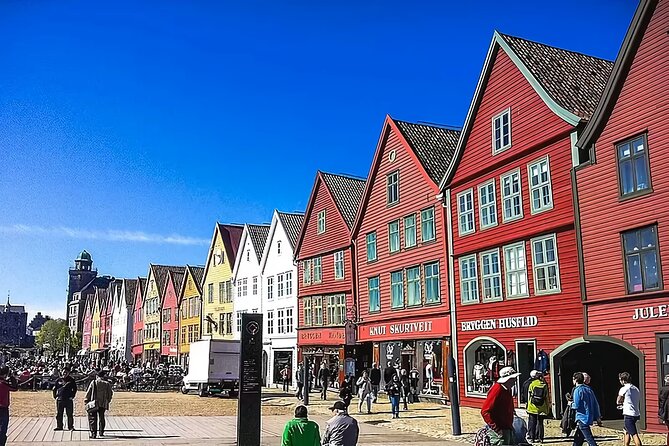
- A water-level view of Bryggen: See Bergen’s famous Hanseatic wharf from an angle you cannot get while walking its narrow lanes.
- More than the city center: The route reaches Skuteviken, Sandviken, Nordnes, Laksevåg, and the wider Byfjorden.
- A useful one-hour introduction: You get a broad look at Bergen before choosing which sights deserve more of your time.
- History with a wartime edge: The route includes the Bruno submarine bunker and sites connected with the Second World War.
- Comfortable for mixed-age groups: Families, older people, and anyone wanting a rest from walking can enjoy the cruise.
- Good value at $28.97: The price is reasonable if you want views and orientation, but less appealing if you expect a small boat or a fully live-guided tour.
Why seeing Bergen from the harbor makes sense
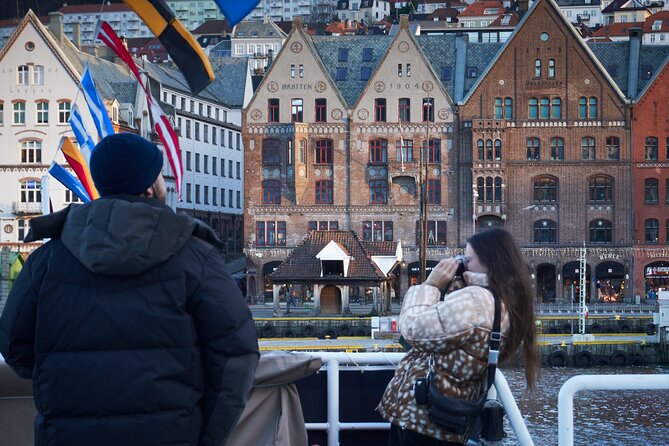
Bergen is often introduced through Bryggen, the Fish Market, and the funicular hills. Those are worthwhile, but the harbor is the city’s front door. The old wharf faced the sea, ships carried goods into Vågen, and fortifications watched the approaches. From the boat, you see how closely the city’s trade, defenses, homes, and industries were tied to the water.
That makes this more useful than a simple ride around the harbor. You get a basic map in your head. Bryggen sits beside Bergenhus Fortress, the wooden homes stretch toward Skuteviken and Sandviken, and the modern city gives way to industrial and residential shores farther out.
The cruise begins at Strandkaien 11, close to the central harbor. It returns to the same meeting point, so you do not need to plan a separate trip back. With a duration of about one hour, you can fit it before lunch, between city sights, or near the end of a walking-heavy day.
The boat is described as comfortable, with indoor seating and an outside deck. On a mild day, the deck is the better choice for photographs and a clear view of the shoreline. On a cold or rainy day, you can sit inside and use the available blankets, though dirty windows or limited sound indoors can reduce the appeal.
More City Tours in Bergen
- Bergen: City Tour on Foot
★ 4.9 · 1,327 reviews - Bergen: City Sightseeing Hop-On Hop-Off Bus Tour
★ 3.8 · 481 reviews - City Walking Tour – Bergen On Foot
★ 5.0 · 436 reviews
Bryggen and St. Mary’s Church from the water
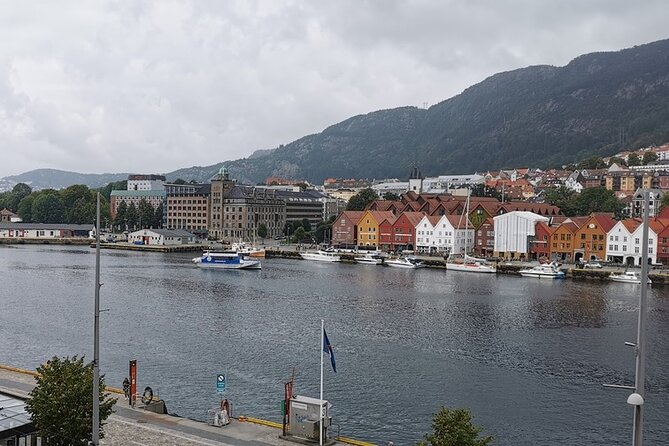
The first major sight is colorful Bryggen, Bergen’s best-known group of old wooden buildings. The wharf began as the city’s main working waterfront, and the surviving buildings form part of a UNESCO World Heritage site. Seen from the water, the long line of façades makes sense in a way it may not from inside the lanes. You see the wharf as a working edge between the town and the sea.
The boat does not replace a walk through Bryggen. You cannot inspect the passages, courtyards, or crooked timber details from the deck. What it does offer is a wide view of the entire frontage, a good way to understand the site before returning on foot.
St. Mary’s Church rises behind the wharf. Completed around 1180, it is Bergen’s oldest surviving building. Its German congregation took control in 1408, and that connection helped preserve the church and gave its interior a more elaborate character than you might expect from a parish church.
Look for the church’s basilica shape, with a tall central nave and lower side aisles. From the boat, you will not study its details closely, but the view helps place this medieval church within the old harbor district. If the narration is difficult to hear outside, note the church before departure and visit it on foot later.
Bergenhus Fortress and the city’s royal past
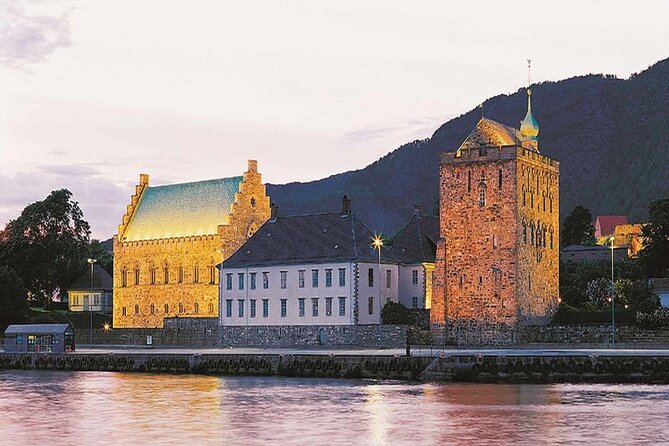
Next comes Bergenhus Fortress, one of Norway’s oldest and best-preserved stone fortifications. The site contains buildings dating to around 1240, when Bergen served as Norway’s capital and the area called Holmen housed the country’s rulers.
The most important building here is Håkon’s Hall, built in 1247. It was the largest and grandest structure in the medieval royal residence. From the boat, the fortress reads as a defensive block along the harbor, but its importance was political as well as military.
This is one of the better parts of the cruise for getting your bearings. Bryggen and Bergenhus sit close together, yet they tell different stories. Bryggen represents the commercial power of the Hanseatic merchants. The fortress represents royal authority, administration, and defense.
The boat gives you a broad view but no time to explore the grounds. If medieval Norway interests you, plan a separate visit to Bergenhus after the cruise. The water view works best as context, not as a substitute.
Skuteviken, Sandviken, and old wooden homes
The route continues along the older shore districts of Skuteviken and Sandviken. Skuteviken grew outside the central city under the protection of Sverresborg Fortress, built in 1183. Small wooden houses appeared without a formal plan, and the area expanded over several centuries.
Its name roughly means ship bay. Merchants connected with Bryggen used the beach here, along with the beach at Bradbenken, when ships needed to be hauled over or worked on. That detail helps explain why the cruise keeps moving beyond the postcard view of central Bergen. The harbor was not just scenery. It was a workplace.
At Måseskjæret, the route passes one of Sandviken’s small islets. Settlement began there in 1804, and the older summer residence at Måseskjæret 1 dates to 1795. The building has a single story, a high hipped roof, and protected heritage status.
Today, modern apartments also shape the islet. That mix is part of the appeal. You see old summer residences, working waterfront traditions, and newer housing sharing the same narrow band of shore. The views are especially good from the outside deck, but wind can make this section uncomfortable in poor weather.
A few more Bergen days to weigh up
- From Bergen: The Original Fjord Cruise to Mostraumen
★ 4.7 · 8,440 reviews - Bergen: Mostraumen Fjord & Waterfall Cruise
★ 4.6 · 2,990 reviews - Bergen: Past & Present Small Group Guided Walking Tour
★ 4.9 · 1,609 reviews - Walking Tour in Bergen of the Past and Present
★ 5.0 · 1,575 reviews
Byfjorden and the story of the sea route
The boat then reaches into the wider Byfjorden, a roughly 15-kilometre stretch separating Askøy from the Bergen Peninsula. The water opens up here, giving you a stronger sense of the setting around Bergen than you get from the tight central harbor.
The fjord also carries a military and trading past. In 1665, during the Second Anglo-Dutch War, an English fleet pursued Dutch ships that had taken shelter in Bergen’s neutral port. Sixty Dutch ships, including ten carrying valuable goods for the Dutch East India Company, were involved. Bergen’s forces joined the Dutch side, and the short battle ended with the English fleet retreating.
A cannonball embedded in Bergen Cathedral’s wall has long been linked with that fight. The story is a reminder that the harbor’s sheltered waters were valuable for trade, but also exposed the city to international conflict.
This part of the cruise may feel less packed with landmarks than the central harbor. That is not a flaw if you want open water and a change of pace. It is less rewarding if you expect a major sight every few minutes.
Laksevåg and the Bruno submarine bunker
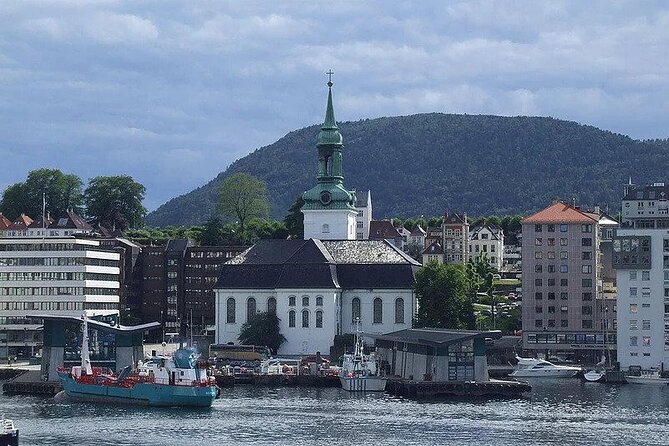
One of the route’s most striking sights is the Bruno submarine bunker at Laksevåg. German occupation forces began building it in 1941, cutting into the mountain and using enormous quantities of steel, sand, cement, and dynamite. Soviet prisoners of war carried out the heavy labor.
The bunker was attacked by Allied aircraft in October 1944. Few bombs hit their target. Most struck nearby homes, killing 193 civilians, including 61 children at Holen school. Two aircraft were shot down.
The five-metre-thick concrete roof still covers three docks. The Norwegian Navy took over the facility in 1952, and it remains in use. You will see the bunker from the water rather than enter it, but the scale is hard to miss. This is not polished sightseeing. It is a stark reminder of Bergen’s wartime experience and the civilian cost of military targets.
The narration matters most here. If you sit outside and cannot hear the speakers, you may miss the context that makes the bunker meaningful. Consider sitting inside for this section, then moving outside when the boat returns to more scenic views.
From shipyard to art center at USF Verftet
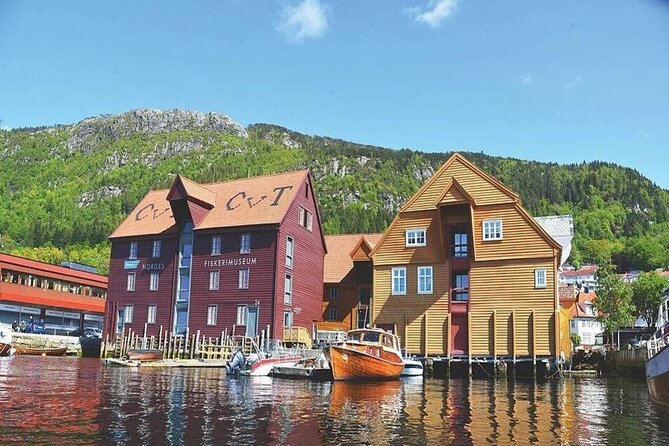
The cruise also passes the former Georgernes Shipyard. Founded in the 1780s, it reached its most productive period after Annanias Dekke took over in 1853. Dekke had learned shipbuilding in Boston and designed large sailing ships that earned him a strong reputation in Norway.
Part of the shipyard later became a sardine factory, once one of the country’s largest. Today the site has a very different role as USF Verftet, a 12,000-square-metre art and culture center with companies working across the arts.
This stop gives you a compact lesson in Bergen’s changing economy. Shipbuilding gave way to food processing, and industrial buildings now support culture. You may not get much detail if the audio is hard to hear, but the buildings themselves show the change.
Nordnes, its fort, pool, aquarium, and churches
The boat rounds the Nordnes peninsula, where Fredriksberg Fortress occupies the highest point. The fort once helped defend the peninsula, and its fire tower later served as part of Bergen’s warning system. When a fire broke out, cannon shots indicated the location in the city.
The military fire service ended in 1926, but the tower remains. From the water, the high position helps explain why the site was useful. You also get a view toward Laksevåg and the central harbor.
Nearby, Nordnes Sea Water Pool dates to 1910. Its original swimming area used floating wooden boxes attached to land by chains. The modern pool opened in 1965, and today the heated saltwater pool is kept at about 29 degrees Celsius. There is also access to the sea, indoor changing space, and a sauna.
The Bergen Aquarium is another recognizable landmark. Opened in 1960, it includes fish, penguins, tropical animals, and more than 60 large aquariums. Outdoor ponds hold penguins, sea lions, otters, and large fish. The cruise only gives you an outside view, but it can help you decide if the aquarium deserves a later visit.
The route also passes Nykirken, the large white church consecrated in 1622. Its name means the new church, though it has been rebuilt several times after fires. The nickname has survived because the church on this site has repeatedly become the newest version of itself.
Customs, Murhvelvingen, and the Fish Market
As the boat returns toward the center, it passes the old customs area. Bergen’s first customs house was built in 1561 and became the city’s largest wooden building. Its jetties extended more than 100 metres into the water, allowing large ships to dock in deeper water.
The Tollbod extension also sheltered the harbor from northwest storms and narrowed the entrance, making smuggling harder. This is the kind of small practical detail that helps you read the waterfront as an old port rather than a row of attractive buildings.
Murhvelvingen was built after the 1561 town fire as a private house and residence for the sheriff of Bergenhus Fortress. Its soapstone corners came from monastery ruins. Fire damaged it again in 1625, 1640, and 1643, and public money helped repair it in 1651.
The lower level has vaulted spaces where shops have operated since the seventeenth century. Dynamite was sold in the basement until the late 1960s, an unsettling detail for a building in the middle of town.
The final major sight is the Fish Market. The square has served townspeople, farmers, fishermen, and merchants for centuries. The outdoor market operates from May through September, while the indoor food hall and restaurants remain open year-round.
From the water, you see the market in its proper setting, beside the harbor where fishermen once rowed in to sell the day’s catch. After the cruise, it is an easy place to continue, though food and drinks are not included in the boat ticket.
Price, sound, weather, and comfort
At $28.97 per person, the cruise is fairly priced for a one-hour orientation, especially if you want to rest while still seeing a large stretch of Bergen. It is a better deal for a first afternoon in town than for someone who has already explored the harbor closely and wants a more specialized excursion.
The vessel can hold up to 92 people, so expect a proper sightseeing boat rather than a small sailboat or private craft. That size brings stability and room for families, but it also means the experience feels less personal.
The recorded narration is the biggest variable. It covers the major sights, but it cannot respond to questions or adjust its timing. Sound has also been inconsistent. On some departures, speakers were difficult to hear outside or were affected by background conversation.
For the best chance of enjoying it, arrive ready to choose your seat based on conditions. Use the outside deck for photographs and open views when the weather is kind. Move indoors when the wind or rain becomes unpleasant, especially during the sections where historical context matters.
Mobile tickets make access simple, and service animals are allowed. The cruise is advertised as wheelchair- and stroller-accessible, though boarding and getting off may be awkward for some wheelchair or walker users. If that is important for your party, confirm the current boarding setup before booking.
The cancellation policy is straightforward: cancel at least 24 hours before departure for a full refund. Cancellations inside 24 hours are not refunded. Because some departures have reportedly been canceled for mechanical problems with little notice, keep your booking details handy and leave room in your day if the cruise is essential.
Who should book the Bergen City Cruise?
I would book this cruise for a first day in Bergen, a family group with mixed ages, or anyone who wants a clear introduction without another long walk. It is also useful after a flight or train journey, when you want to see the city but your legs need a break.
You should book it if the idea of seeing Bryggen, the fortresses, old timber districts, wartime structures, and Byfjorden in one hour appeals to you. The route covers a lot of ground and gives you good photo chances from the water.
I would skip it if you want a lively live guide, a small intimate boat, or detailed commentary at every sight. Rain and poor visibility can also take some of the pleasure away, and the recorded audio is not always clear outdoors.
For most visitors, the best use is as an opening chapter. Take the cruise, note the places that catch your eye, then return on foot to Bryggen, Bergenhus Fortress, the Fish Market, or the aquarium. At this price and length, it is a sensible way to understand Bergen’s waterfront before spending the rest of your day on land.
FAQ
How long is the Bergen City Cruise?
The cruise lasts approximately one hour.
Where does the cruise depart?
It departs from Strandkaien 11, 5014 Bergen, Norway.
Where does the cruise end?
The cruise returns to the same meeting point at Strandkaien 11.
How much does the cruise cost?
The listed price is $28.97 per person.
Is food included?
No. Food and drinks are not included.
Is the cruise narrated?
Yes. The cruise includes narration about Bergen’s sights, though the commentary may be recorded rather than delivered live.
What landmarks can I see?
The route includes Bryggen, St. Mary’s Church, Bergenhus Fortress, Skuteviken, Sandviken, Byfjorden, the Bruno submarine bunker, USF Verftet, Fredriksberg Fortress, Nordnes, Bergen Aquarium, Nykirken, the old customs area, Murhvelvingen, and the Fish Market.
Is the cruise suitable for wheelchair users and strollers?
The activity is advertised as wheelchair- and stroller-accessible. Boarding and getting off may be difficult for some wheelchair or walker users.
Are service animals allowed?
Yes, service animals are allowed.
What is the cancellation policy?
You can cancel for a full refund if you do so at least 24 hours before the scheduled start time. Cancellations made less than 24 hours before departure are not refunded.
Just added around Bergen
- Mostraumen Private Pontoon Cruise★ 4.5 · 7 reviews
- Walking Tour of Central Bergen★ 5.0 · 46 reviews
- Walking tour: Medieval Spirit of Bergen + sweet Arctic gifts★ 5.0 · 17 reviews
- Bergen : Private Waterfalls and Wonders Tour in Norway★ 5.0 · 6 reviews
- Walk with a Witch in 16th Century Bergen: A Self-Guided Fictional Tour★ 4.5 · 12 reviews
- Three-summit hike in Bergen★ 5.0 · 3 reviews
- Bergen: Private Full-Day Roundtrip to Hardangerfjord with cruise★ 5.0 · 20 reviews
- 2-Day Round Trip from Bergen: THE GRAND SOGNEFJORD – fjords, waterfalls, glacier★ 5.0 · 4 reviews
City Tours, compared.
Grand City Sightseeing Tour by Bus with Fjord Cruise
Read our review →
Oslo Combo Tour: Grand City Tour and Oslo Fjord Cruise
Read our review →
Browse the lists this tour appears in