
Reviewed · WALKING TOURS
Walking Tour in Bergen of the Past and Present
Bergen’s story unfolds neatly on foot, from the old royal seat at Bergenhus Fortress to the Hanseatic warehouses of Bryggen, then uphill into quiet wooden-house streets. The tour does more than point out pretty buildings: it connects Norway’s medieval politics with the price of a house, local food, taxes, work, and the country’s love of hiking.
I especially like the small maximum of 16 people, which leaves room for questions, and the useful split between history and present-day life. Guides such as Jeff, Dane, Janine, Emma, Anaïs, and Magda have been praised for clear storytelling, humor, and practical restaurant advice. The main consideration is the uphill walk, uneven cobblestones, and the fact that you do not enter the museums or churches.
Key things to know before you book
- Start at Bergenhus Fortress: Begin where Bergen’s medieval palace once stood, a fitting place to get your bearings.
- See Bryggen with context: Spend about 40 minutes learning how German Hanseatic merchants shaped the wharf and the city.
- Walk into Fjellsiden: The route climbs through old wooden-house neighborhoods and turns toward everyday Norwegian life.
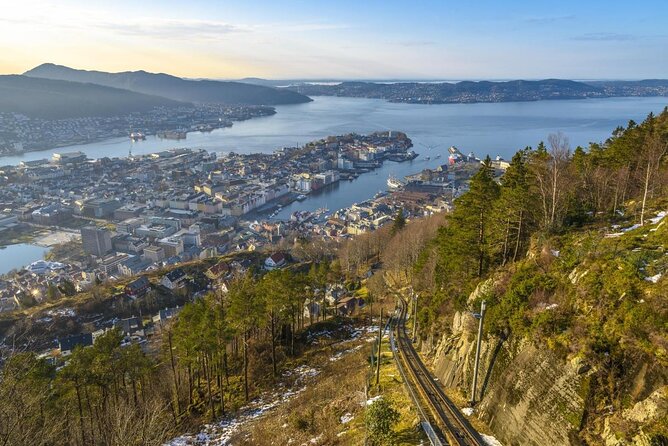
- Skip the funicular by design: You pass the station, but the tour does not include the ride, leaving you free to return later for views or a hike.
- Finish near the fish market: The walk ends by the tourist office, handy for continuing your day.
- Pay for an outdoor introduction: At $33.47 per person, the tour offers two hours of guided orientation without admission fees.
Why this is a useful first look at Bergen
Bergen can seem simple at first glance: harbor, colorful wooden buildings, mountains, and rain. This walk gives those pieces a time line. You start with kings and medieval power, move into trade and commerce, then finish with the city as it is lived today.
That order works well. Instead of treating Bergen’s sights as separate photo stops, the guide explains how the royal center, the merchant wharf, the church, the hillside homes, and the food streets fit together. You get a sense of why the city grew where it did and how old Bergen still shapes modern life.
The English-language format is useful for first-time visitors, especially if you want more than a quick list of dates. Guides are local, and the strongest part of the experience appears to be their ability to connect facts with ordinary life. You might hear about local meals, work habits, housing costs, taxes, shops, and restaurant choices alongside major events in Norwegian history.
The tour is also a good early-day choice. Its practical tips can help you decide what to do afterward, from visiting a museum to eating along Skostredet or returning to the funicular station later.
More Walking Tours in Bergen
- Bergen: Past & Present Small Group Guided Walking Tour
★ 4.9 · 1,609 reviews - City Walking Tour – Bergen On Foot
★ 5.0 · 436 reviews - Bergen: Sightseeing Walking Tour with Ferry Ride
★ 4.9 · 296 reviews
Starting at Bergenhus Fortress
Meet at Bradbenken 1, near Bergenhus Fortress. Public transportation is nearby, and the meeting point is easy to fold into a day in the city.
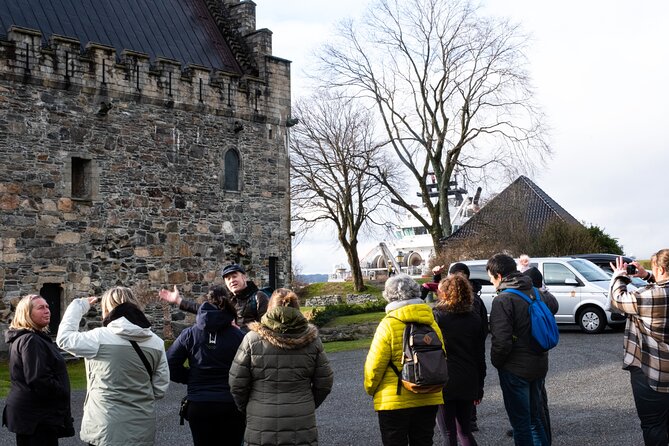
The fortress is a strong opening because Bergen was once Norway’s capital, and this was the location of the palace. You are not beginning with a random monument. You are beginning at the old center of royal authority.
The guide leads you through the fortress area and explains what it meant when Bergen had a more independent political role. The setting gives the first part of the walk a useful sense of place, especially if you know little about Norway before arriving.
You pass Håkon’s Hall, the major surviving section of the medieval palace. The guide discusses Bergen’s time as an independent country and explains Norway’s later unions with Denmark and Sweden. This is a helpful correction to the idea that Norwegian history can be understood only through modern national borders.
One practical point matters here: you do not enter Håkon’s Hall. It is a museum with its own admission charge, and this experience stays outdoors. On rare occasions, a private event can close the fortress, so the exact opening section may change.
Bryggen and the Hanseatic merchants
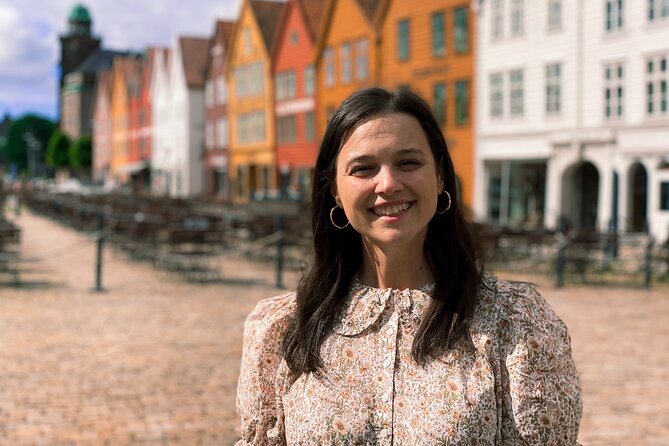
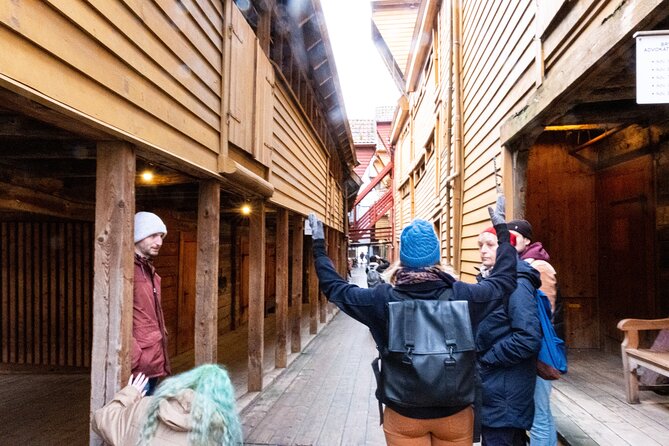
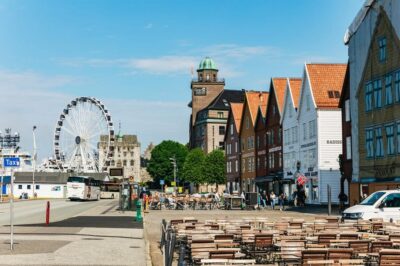
From the fortress, the walk continues to Bryggen, Bergen’s UNESCO World Heritage site. This is the visual centerpiece of the tour, with narrow passages and old wooden buildings along the harbor.
Bryggen has been a trading area for roughly 1,000 years, but the guide focuses especially on the Hanseatic League. German merchants built a powerful trading system here, and their methods shaped how the wharf operated. You learn about their trading practices, rules, and the way the merchant district functioned.
That background makes Bryggen more interesting than a row of colorful façades. The narrow wooden passageways are not simply picturesque. They reflect a working commercial district, where merchants stored goods, negotiated deals, and organized daily business around the waterfront.
The tour spends about 40 minutes in this area. That is enough time to look closely, ask questions, and understand the basic system without turning the whole walk into a lecture.
You do not enter the Bryggen buildings. Today, they contain shops and small businesses rather than museums included in the tour. If you want an indoor visit, you will need to arrange that separately and pay any applicable admission.
For photography, this section gives you the classic Bergen scenes. For history, it gives you the economic explanation that makes those scenes matter. I like that balance. You get the picture, then the reason behind it.
St. Mary’s Church and the older city
The next historical stop is St. Mary’s Church, the oldest surviving building in Bergen. It was built in the 12th century and still functions as a church.
The guide uses the church to continue the story of medieval Bergen, shifting from royal power and trade to religious life and the physical age of the city. You can appreciate the building from outside and place it within the larger route.
Again, the tour does not enter. St. Mary’s has a separate admission fee, so this is an exterior explanation rather than a museum visit. That limitation is worth noting if your main goal is to see the interiors of Bergen’s historic buildings.
Still, the outside stop fits the tour’s purpose. You are getting a guided framework for the city, not a ticketed tour of every attraction. The walk keeps moving and leaves you time later to choose the interiors that interest you most.
Same base, a completely different kind of day:
- From Bergen: The Original Fjord Cruise to Mostraumen
★ 4.7 · 8,440 reviews - Bergen: Mostraumen Fjord & Waterfall Cruise
★ 4.6 · 2,990 reviews - Bergen: City Tour on Foot
★ 4.9 · 1,327 reviews - Bergen: Viking Village, Nærøyfjord Cruise & Flåm Railway
★ 4.8 · 1,047 reviews
Climbing into Fjellsiden
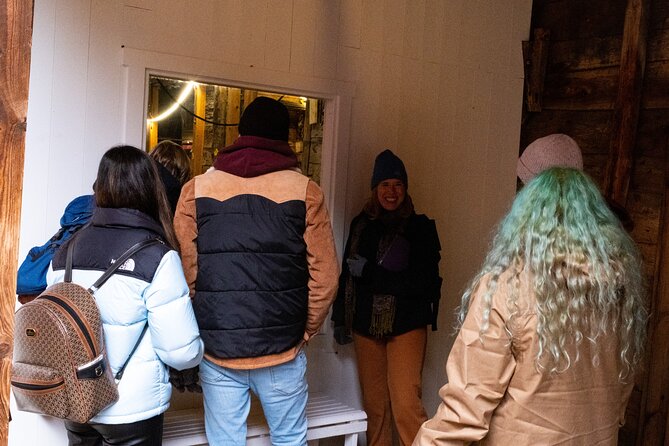
After the main history section, the route heads uphill toward Fjellsiden. This is where the character of the tour changes.
Fjellsiden is a well-preserved area of wooden houses, and the guide discusses ordinary life in Norway. Topics can include what people eat, when they work, house prices, taxes, and other details of living in Bergen. These are the questions that help a city feel real after the monuments have been covered.
The exact route depends on the guide’s interests. That gives the experience a local feel, though it also means the walk is not identical every time. Guides may take you along back streets or less obvious corners rather than following only the busiest sightseeing path.
Several people have singled out this local angle as one of the tour’s best features. Guides have offered coffee, food, shop, and restaurant suggestions, and some have taken the group through quieter lanes instead of sticking to the main tourist route. You should not expect a guaranteed café stop or a fixed list of businesses, but you can expect the guide to discuss modern Bergen and respond to your questions.
The climb is the main physical issue. The tour requires moderate fitness, and the route includes uphill walking and some uneven cobblestones. Comfortable shoes are a sensible choice. If stairs, slopes, or rough paving are difficult for you, this may not be the right way to see the city.
The funicular station and Norway’s outdoor culture
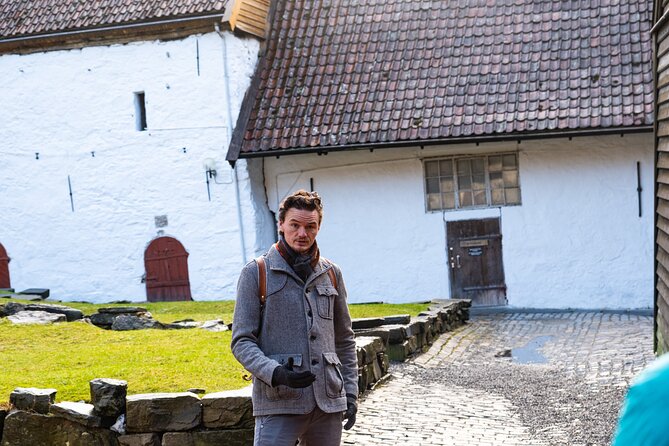
The walk passes the funicular station, but the group does not ride it. This is an intentional choice, not a missing part of the experience.
The guide talks about outdoor life and the importance of hiking in Norwegian culture. That subject makes sense in Bergen, where access to hills and walking routes is part of everyday life. The guide can explain why hiking is more than a holiday activity for many people in Norway.
The funicular ride would add about an hour and cost 150 NOK. By leaving it out, the tour stays close to two hours and keeps the price at $33.47 per person. You can return later at your own pace, perhaps for a sunset visit or to combine the ride with a hike.
This is a good example of the tour’s value. It does not try to include every paid attraction. Instead, it gives you the context to decide which ones deserve your time and money.
Skostredet and Bergen’s food culture
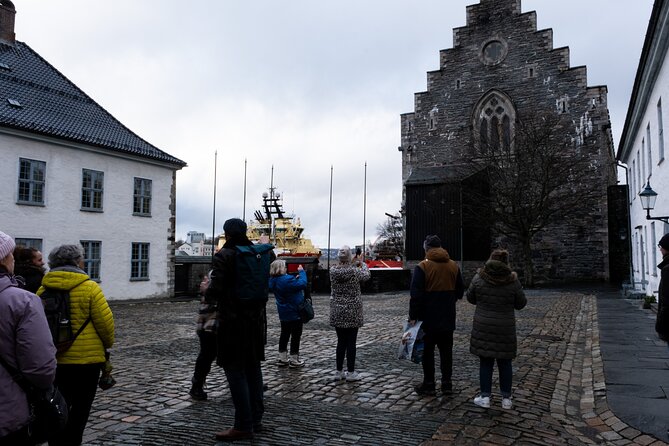
The final 20 minutes turn toward modern Bergen and food. The group walks along Skostredet, a popular restaurant street in the old town center.
Bergen is a UNESCO City of Gastronomy, so this is more than a quick walk to the finish. The guide discusses local food culture and may suggest places for coffee, dinner, or regional treats. Several guides, including Jeff, Anaïs, and Emma, have been praised for useful eating advice.
This section is especially helpful if you have only just arrived. A restaurant recommendation is more useful after you have heard the guide explain local habits and ingredients, rather than receiving a generic list of places.
Skostredet also provides a change of mood. After fortifications, medieval politics, and merchant history, you reach a street that shows Bergen as a place where people eat, meet, and spend time today.
Finishing beside the fish market
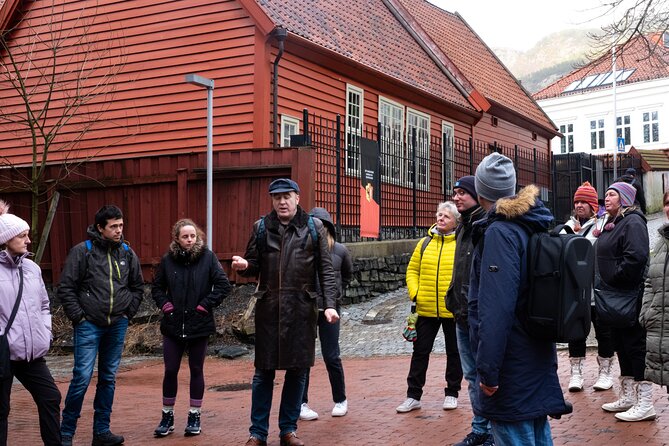
The tour finishes at Vågsallmenningen 2, outside the fish market and near the Bergen tourist office. This is a practical ending point.
From here, you can continue around the harbor, visit the market, ask for more city information, or head to another attraction. The finish also works well for cruise passengers and anyone who wants to stay in the center after the walk.
The route is compact rather than sprawling. One guide described the touring area as not huge, but sufficient to bring Bergen’s history to life. That is a fair way to think about it. You are not trying to cover every hill and neighborhood. You are building a strong first picture of the old city in a manageable two-hour walk.
Guides, group size, and the feel of the walk
The tour is offered in English and has a maximum of 16 people. That is small enough for a more personal exchange, though the actual group may be smaller. On one occasion, a guest had a private experience with a guide because nobody else had booked.
The guides named in the feedback include Jeff, Dane, Janine, Emma, Magda, Anaïs, Neil, Erik, and Eriik. The consistent strengths are clear speaking, humor, local suggestions, and an openness to questions. Some guides have stayed a little longer to finish the material, but you should plan on approximately two hours rather than counting on an extension.
A good guide matters on a city walk, and this experience depends on conversation as much as scenery. You will get the most from it if you ask about food, daily life, language, transport, or places to visit afterward.
Price, timing, and what you receive
At $33.47 per person, the tour is reasonably priced for two hours with an authorized guide. There are no hidden fees for the walking experience, and the fee covers guided walks at Bergenhus Fortress and Bryggen.
The price does not include entry to Håkon’s Hall, St. Mary’s Church, or other buildings and museums. It also does not include the funicular, which costs 150 NOK and would add about an hour.
That makes the tour a good value if you want orientation, stories, and local advice. It is less suitable if you want a full museum visit or a ticket that bundles several attractions.
Bookings are often made well ahead, with an average lead time of 38 days. Free cancellation is available up to 24 hours before the start time. The tour depends on good weather and a minimum number of participants. If poor weather or low enrollment causes a cancellation, you can receive a different date or a full refund.
Who should book this Bergen walk?
I would choose this tour for a first visit, especially if you want to understand Bergen before choosing your museums and paid attractions. It also suits repeat visitors who want a local view of the city rather than another trip through only the main postcard stops.
It works well for cruise passengers with enough time in port, provided you can manage a two-hour walk with an uphill section. Couples, solo visitors, and small groups should find the size comfortable.
I would think twice if you need step-free movement, dislike cobblestones, or want to spend most of your time indoors. The tour is outside, includes a climb, and does not enter the major historic buildings.
Should you book Walking Tour in Bergen of the Past and Present?
Book it if you want a clear introduction to Bergen that joins royal history, Hanseatic trade, wooden homes, hiking culture, and modern food life. The strongest reason to choose it is the mix of major sights and ordinary local detail.
Skip it if you mainly want entrance tickets or a ride up the mountain. For most first-time visitors who can handle the hill, $33.47 buys a useful two-hour orientation, practical advice, and a better understanding of what you are seeing after the guide says goodbye.
FAQ
How long does the walking tour last?
The tour lasts approximately two hours.
What language is the tour offered in?
The tour is offered in English.
What is the price per person?
The listed price is $33.47 per person.
Where does the tour start?
The tour starts at Bradbenken 1, 5003 Bergen, Norway, near Bergenhus Fortress.
Where does the tour finish?
It finishes at Vågsallmenningen 2, 5014 Bergen, near the Bergen tourist office and the fish market.
Does the tour enter Håkon’s Hall?
No. The tour visits the area and explains its history, but it does not enter Håkon’s Hall. The museum has a separate admission fee.
Does the tour enter the buildings at Bryggen?
No. The Bryggen portion takes place outdoors, and the buildings currently contain shops and small businesses.
Is the funicular ride included?
No. The group passes the funicular station but does not ride it. The ride would add about an hour and costs 150 NOK.
What happens if the tour is canceled?
If poor weather or an insufficient number of participants causes cancellation, you will be offered a different date or experience, or a full refund. You can also cancel for a full refund up to 24 hours before the start time.
Just added around Bergen
- Mostraumen Private Pontoon Cruise★ 4.5 · 7 reviews
- Walking Tour of Central Bergen★ 5.0 · 46 reviews
- Walking tour: Medieval Spirit of Bergen + sweet Arctic gifts★ 5.0 · 17 reviews
- Bergen : Private Waterfalls and Wonders Tour in Norway★ 5.0 · 6 reviews
- Walk with a Witch in 16th Century Bergen: A Self-Guided Fictional Tour★ 4.5 · 12 reviews
- Bergen: Private Full-Day Roundtrip to Hardangerfjord with cruise★ 5.0 · 20 reviews
- 2-Day Round Trip from Bergen: THE GRAND SOGNEFJORD – fjords, waterfalls, glacier★ 5.0 · 4 reviews
- Three-summit hike in Bergen★ 5.0 · 3 reviews
Walking Tours, compared.
Past & Present Small Group Guided Walking Tour
Read our review →

Central Oslo Guided Walking Tour with Local Guide
Read our review →Browse the lists this tour appears in