
Reviewed · SELF-GUIDED TOURS IN BERGEN
Bergen in Your Pocket: Landmarks and Lore Audio Tour
Bergen’s story unfolds through its streets on this self-guided walk, beginning with King Olav Kyrre and ending with writer Ludvig Holberg. Along the way, you’ll connect the city’s medieval royal past, seafaring trade, famous artists, and Nazi occupation to the buildings and statues around you. The 17th-century cannonball in Bergen Cathedral is the kind of small, easy-to-miss detail that makes this route worthwhile.
I like the flexible pace and the offline map, which let you pause for photographs, coffee, or a closer look without holding up a group. I also like the price: $8.99 buys lifetime access in English, making this a practical first walk in Bergen or a useful companion to a longer visit.
The main consideration is that this is an audio tour, not a live guide. You need your own smartphone and headphones, and the narration does not take you inside museums or other attractions along the route.
Key points about Bergen in Your Pocket
- A 45 to 75 minute route: Walk from the King Olav Kyrre sculpture to the Ludvig Holberg statue through central Bergen.
- Offline access: Download the audio, map, and geodata in the VoiceMap app before setting out.
- Art and public monuments: See statues of Christian Michelsen, Edvard Grieg, Ole Bull, Henrik Ibsen, and Ludvig Holberg.
- Bergen’s darker chapter: Pass the Gestapomuseet and hear about the Nazi occupation and the prison escape route.
- A small but memorable detail: Look for a 17th-century cannonball lodged in the façade of Bergen Cathedral.
- Good value for independent walkers: The $8.99 price includes lifetime access in English, with no transport, food, or entry fees included.
Starting with King Olav Kyrre in central Bergen
The walk begins at the steel sculpture of King Olav Kyrre on Strømgaten. This opening gives you a useful frame for the city: Bergen began as a small coastal settlement, then expanded into a major centre of power and trade.
The narration introduces Bergen as a former medieval capital of Norway and a commercial centre for Scandinavia until the 1600s. That context matters because the streets ahead are not simply a collection of attractive squares and old buildings. They reflect a city shaped by royal government, maritime trade, and its position as the gateway to Norway’s fjords.
The start is also practical. You are already in the city centre, and the route is designed as a walk rather than a sightseeing circuit requiring transport. The advertised time is about 45 minutes to 1 hour 15 minutes, but your actual pace will depend on how often you stop.
You can follow the audio closely, pause it while taking pictures, or move at your own speed. One useful feature is the map inside the VoiceMap app. The app provides offline access to the audio, map, and geodata, so you do not need to depend on a live mobile connection during the walk.
More Self-Guided Tours in Bergen
- Bergen: Self-Guided Round-Trip Full-Day Excursion
★ 4.5 · 158 reviews - Self-Guided Full Day Round-trip From Bergen
★ 4.5 · 76 reviews - Bergen: Self-Guided Day Trip to Oslo
★ 4.6 · 46 reviews
Festplassen and Bergen’s public squares
The route moves through Festplassen Plaza, one of the city’s popular open squares. This is a good early point to notice how Bergen uses public space. The walk is not limited to headline attractions. It links plazas, parks, monuments, and ordinary central streets into one story.
You then see the statue of Christian Michelsen, a Norwegian politician and national hero. His presence gives the tour a political thread alongside its focus on art and architecture. The route does not ask you to study a single museum collection. Instead, it uses outdoor monuments as prompts for understanding the people who helped shape Norwegian public life.
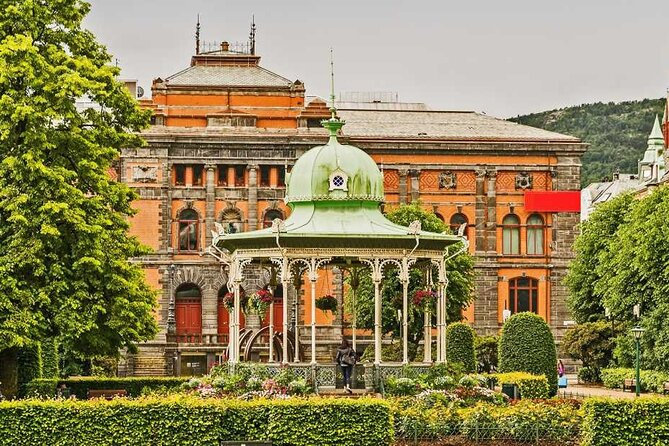
From there, you continue through city parks and squares, including the Musikkpaviljongen, or Music Pavilion. These stops break up the denser city-centre walk and give you room to look around rather than simply move from one landmark to the next.
The plaza and park sections are especially useful if you want to get your bearings in Bergen. They create a sense of the city’s central layout before the route turns more firmly toward individual statues, major buildings, and the waterfront side of town.
Grieg, Ole Bull, and Ibsen in one city-centre walk
Bergen’s cultural identity comes into focus through three major figures. You see a statue of composer Edvard Grieg, one of Norway’s best-known musicians, and hear a little about him as you walk.
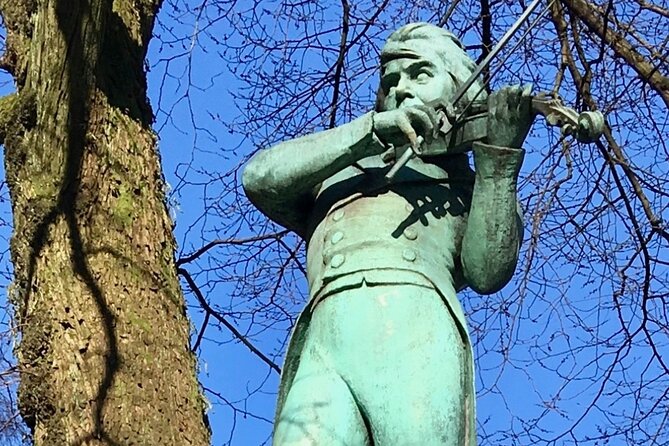
The route then takes you to the statue of violinist Ole Bull, positioned on top of a fountain. Its setting makes it more than a quick name on a plaque. You can see how public art is folded into the city’s streets and squares, where it becomes part of daily movement rather than something kept behind museum doors.
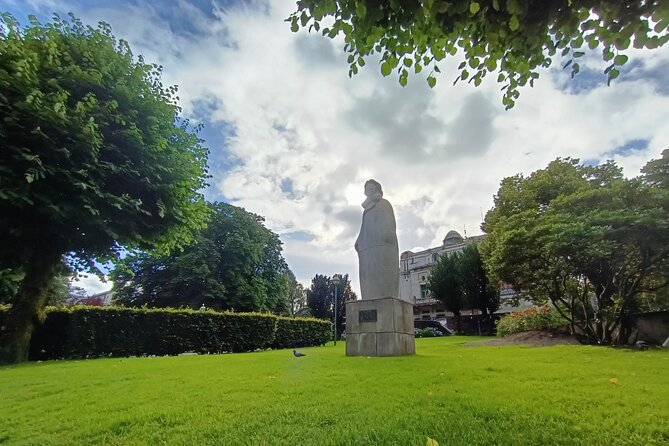
Next comes the granite statue of playwright Henrik Ibsen. These three stops give the walk a clear artistic arc, but they also help explain why Bergen is associated with Norwegian culture far beyond its scenery and fjord excursions.
I like this section because it gives you several points of interest without asking you to commit to an indoor attraction. If your time in Bergen is short, you can see important cultural figures while continuing through the centre. The tradeoff is that the tour can only offer the outdoor view and spoken context. It does not guide you into museums, exhibitions, or other attractions.
The National Theatre and Bergen Cathedral
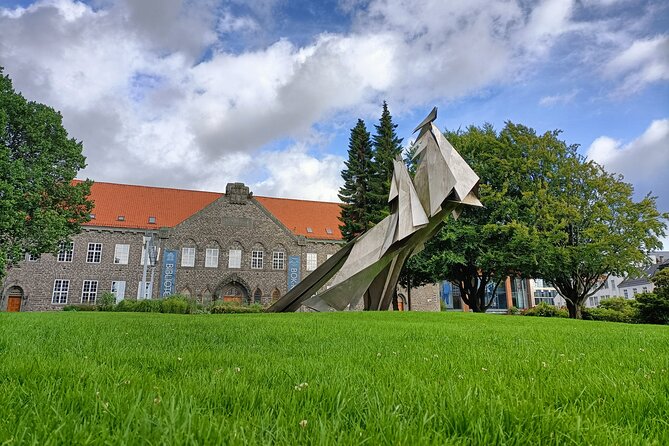
The route continues through the city centre, passing important buildings such as the National Theatre and Bergen Cathedral. These landmarks shift the focus from individual personalities to the institutions that give the city its public shape.
The cathedral is particularly rewarding for anyone who pays attention to small details. Look for the 17th-century cannonball embedded in its façade. It is easy to pass without noticing, and the audio helps turn an ordinary exterior inspection into a search for a specific piece of evidence from Bergen’s past.
This is one of the tour’s better qualities. You are not only told to look at a famous building. You are given a detail to find. That makes you more alert to the street around you and gives the walk a simple sense of discovery without requiring an entry ticket.
Keep in mind that the route does not include a guided visit inside Bergen Cathedral or the National Theatre. If you decide to enter any attraction mentioned along the way, you pay separately and visit independently.
Same base, a completely different kind of day:
- From Bergen: The Original Fjord Cruise to Mostraumen
★ 4.7 · 8,440 reviews - Bergen: Mostraumen Fjord & Waterfall Cruise
★ 4.6 · 2,990 reviews - Bergen: Past & Present Small Group Guided Walking Tour
★ 4.9 · 1,609 reviews - Walking Tour in Bergen of the Past and Present
★ 5.0 · 1,575 reviews
The Gestapomuseet and Bergen’s wartime story
The stop by the Gestapomuseet introduces a darker part of Bergen’s past. Here, the narration covers the Nazi occupation and explains the only way prisoners could escape from the torture rooms.
This section changes the mood of the walk. Until this point, much of the route has centred on kings, politicians, musicians, writers, squares, and civic buildings. The Gestapomuseet reminds you that Bergen’s streets also carry the memory of occupation and imprisonment.
For me, this is an important reason to choose a history-focused audio walk rather than a route devoted only to scenic views. The story connects a visible place in the city to events that may not be obvious from the outside. You can pause here if you want to consider the subject, rather than being rushed onward by a group schedule.
The same limitation applies as elsewhere: you pass by the museum, but the audio tour does not guide you through its interior. Admission, if you choose to visit, is separate.
Torgallmenningen and the Sailor’s Monument
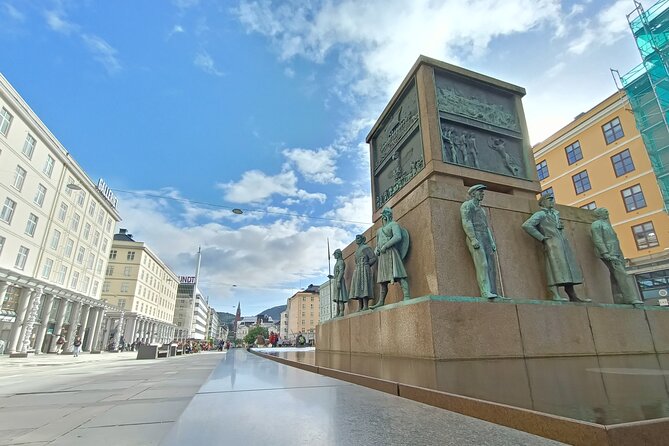
After the wartime stop, the walk heads down Torgallmenningen toward the Sailor’s Monument. This broad city-centre route brings Bergen’s maritime identity into sharper focus.
The Sailor’s Monument honours Norwegian sailors, their work, and their adventures at sea. It is one of the city’s most respected landmarks, and it fits neatly with Bergen’s long role as a coastal trading centre.
This part of the route helps explain the connection between Bergen’s past and its present reputation as Norway’s gateway to the fjords. The city is not only a base for scenic excursions. Its identity was built through contact with the sea, commercial routes, and people who travelled far beyond Norway.
The monument is also a good example of how the tour works best. You receive enough direction and context to appreciate a public landmark, but you remain free to linger. If you are using the walk on a rainy day, which is always a possibility in coastal Bergen, the ability to stop or shorten your visit may be more useful than a fixed group departure.
Skotstredet and the final statue
The route then leads you to Skotstredet, described as one of Bergen’s hippest areas. This gives the walk a modern counterpoint to the medieval, political, artistic, and wartime subjects that came earlier.
Skotstredet is not presented as a separate attraction with an admission fee. Rather, it is part of the changing character of the city centre. You move from formal monuments and major institutions into an area associated with contemporary city life.
The tour ends in Vågsallmenningen square, in front of the statue of Ludvig Holberg. Holberg was a writer and poet, and the statue is among Bergen’s oldest. Ending with him brings the cultural strand back into focus after the maritime and wartime sections.
The finish is convenient for continuing your own visit, but the tour does not provide onward transport. You will need to make your own plans after reaching the square.
What the $8.99 price really buys you

At $8.99 per person, this is inexpensive compared with a live walking tour. The value is strongest if you want an introduction to Bergen’s central landmarks without paying for a guide, joining a fixed group, or booking a longer excursion.
You are paying for more than a simple audio file. The VoiceMap app includes the route map, geodata, and offline access, plus lifetime access to the English tour. That lifetime option is useful if you want to repeat the walk, share the route within your own booking arrangement, or return to the narration later.
The price does not cover a smartphone, headphones, transportation, food, drinks, or attraction admission. Those exclusions are easy to understand, but they matter when you compare the cost with a guided tour. Bring a charged phone and headphones, and download the content before beginning.
The rating is 4.6 from 22 reviews, with 95 percent recommending the experience. The praise focuses on clear audio, an easy-to-follow map, and the freedom to move at your own pace. One person noted that a statue was difficult to find, possibly because it was being renovated. That is a fair warning: public monuments can be moved, obscured, or temporarily unavailable.
How to get the most from the VoiceMap format
Start by checking that the VoiceMap app works on your Android or iOS phone. Since offline access is included, download the audio, map, and geodata before you leave reliable Wi-Fi.
Use headphones so you can hear the narration clearly, but keep enough awareness of traffic and other people around you. The tour is designed for your group alone, so you do not have to match another group’s pace.
Allow at least 45 minutes for the basic route. If you stop at every statue, take photographs, pause the narration, or enter an attraction independently, the walk can take closer to the longer estimate or more.
The tour is offered in English only. That makes it a good choice if you are comfortable following spoken English, but it will not suit someone looking for another language option.
The route is also best for people who like to look around while walking. If you want a guide to answer questions, adjust the route, or lead you inside museums, choose a live tour instead. If you prefer independence and a low price, the audio format is a strong fit.
Who should book this Bergen walk?
I would choose this tour for a first visit when I wanted a quick introduction to central Bergen before deciding which attractions deserved more time. It is also useful on a short port call or a free morning, since the walk is compact and does not require transport.
History fans will appreciate the mix of medieval royal origins, commercial power, wartime occupation, and maritime tradition. Art and literature fans get statues of Grieg, Ole Bull, Ibsen, and Holberg without needing to build a separate route.
It is less suitable if your main aim is the fjords, mountain views, or extensive museum time. The tour stays focused on city landmarks, and it does not include transport into the surrounding mountains or guided visits inside attractions.
Free cancellation is available if you cancel at least 24 hours before the start time. Cancellations within 24 hours are not refunded, and changes during that period are not accepted.
Should you book Bergen in Your Pocket?
Book it if you want a low-cost, self-paced introduction to Bergen with useful historical links between statues, squares, buildings, and public monuments. The offline map and lifetime access make the $8.99 fee easy to justify, especially for independent visitors.
Skip it if you want a live person, detailed museum access, or a route built around the fjords and mountains. For everyone else, this is a sensible way to spend an hour in central Bergen, with enough specific details, including the cathedral cannonball and the Gestapomuseet stop, to make the walk more than a simple stroll.
FAQ
How long does the Bergen audio tour take?
The tour takes approximately 45 minutes to 1 hour 15 minutes. Your timing may vary depending on how often you pause or stop to look at the landmarks.
Where does the tour begin?
It begins in front of the steel sculpture of King Olav Kyrre at Strømgaten 6, 5015 Bergen, Norway.
Where does the tour end?
The tour ends in Vågsallmenningen square at the Ludvig Holberg Statue, Vågsallmenningen 4, 5014 Bergen, Norway.
What language is the audio tour offered in?
The tour is offered in English.
What is included in the price?
The price includes lifetime access to the English tour, the VoiceMap app for Android and iOS, and offline access to the audio, maps, and geodata.
Do I need to bring my own phone and headphones?
Yes. A smartphone and headphones are not included. Transportation, food, and drinks are also not included.
Can I visit the museums and attractions mentioned along the route?
The audio tour does not guide you through museums or other attractions. If you choose to enter one, you must pay for admission independently.
More Audio Tours in Bergen
- Audio Walking Tour in Bergen Famous Ghosts Location
★ 5.0 · 4 reviews - Oslo: Scenic Fjord Cruise with Audio Guide Commentary
★ 4.5 · 5,375 reviews - Molde: Atlantic Ocean Road & Varden Audio Guide Bus Tour
★ 4.1 · 473 reviews - Geiranger: Bus Tour with Multilingual Audio Guide
★ 4.0 · 317 reviews
Just added around Bergen
- Mostraumen Private Pontoon Cruise★ 4.5 · 7 reviews
- Walking Tour of Central Bergen★ 5.0 · 46 reviews
- Walking tour: Medieval Spirit of Bergen + sweet Arctic gifts★ 5.0 · 17 reviews
- Bergen : Private Waterfalls and Wonders Tour in Norway★ 5.0 · 6 reviews
- Walk with a Witch in 16th Century Bergen: A Self-Guided Fictional Tour★ 4.5 · 12 reviews
- Bergen: Private Full-Day Roundtrip to Hardangerfjord with cruise★ 5.0 · 20 reviews
- 2-Day Round Trip from Bergen: THE GRAND SOGNEFJORD – fjords, waterfalls, glacier★ 5.0 · 4 reviews
- Three-summit hike in Bergen★ 5.0 · 3 reviews
Self-Guided Tours in Bergen, compared.



Walk with a Witch in 16th Century Bergen: A Self-Guided Fictional Tour
Read our review →
Self-Guided Roundtrip (Sognefjord Cruise 5h & Flamsbana)
Read our review →
Audio Walking Tour in Bergen Famous Ghosts Location
Read our review →
Self-Guided Trip to Oslo with Sognefjord cruise (5h)
Read our review →Browse the lists this tour appears in